Monday, December 6, 2010

Reviewing "Presidential Leadership in Political Time"

Stephen Skowronek’s Presidential Leadership in Political Time: Reprise and Reappraisal is an important book in the presidential studies canon and I am glad that I encountered it early in my reading.


This series on VeepCritique is an effort to warm-up as I prepare to work on my dissertation proposal. I will be reviewing most of the books I was assigned for my specialized reading exam. With each book there will be a series of basic questions:

1. What is the book’s fundamental question and argument?
2. What is the book’s methodology and analytical framework (and what can I learn from it)?
3. Is the book’s argument compelling?
4. What does the book offer my thesis, what can I take from it?

Skowronek’s 1993 book, The Politics Presidents Make won the Richard E. Neustadt Prize for research on the presidency. Presidential Leadership in Political Time revisits the his initial argument about a decade and a half (and a pair of consequential presidencies) later.

He begins by summarizes to dominant arguments about the presidency. The first is that of Richard Neustadt in Presidential Power (to be reviewed later in this series). Neustadt and his progressive generation (Neustadt came of age under FDR, worked in the Truman White House, and advised JFK) saw the presidency as an engine for reform. His book examined the limitations on the president and but how with careful strategy the President can maximize his (and one day her) effectiveness. The focus is on the personal attributes and cleverness of the president. A pair of lousy presidencies (LBJ and Nixon) led to the rise of the antithesis, Arthur Schlesinger’s “Imperial Presidency” in which an out of control presidency is the center of the nation’s biggest problem. Jimmy Carter’s term did little to inspire confidence in the future of the Presidency. Where Neustadt highlighted the president’s skill – Schlesinger worried about the impact of the president’s neuroses. But then came Reagan and also Clinton who managed to serve two terms each, leave office relatively popular, and manage some substantial accomplishments. Skowronek believes another paradigm is in order:
The outstanding question of our third look is whether these stories fit larger patterns in the politics of leadership, whether it is possible to observe across the broad history of leadership efforts something more systematic about the political impact of presidential action in time and over time.
Skowronek describes the presidency as a fundamental force of upheaval and change. The president has enormous power. The challenge is in Presidential authority – does the President have a warrant for his actions that legitimates them? When Presidents lose that warrant, their allies are discouraged and their foes are energized.

The great struggle for Presidents is to define their actions in terms of a broader purpose that is coherent and consonant with the values of their supporters. So far, this does not sound out of joint with Neustadt’s description of Presidential reputation or prestige.

But, Skowronek explains that the most important factor in a president’s efforts to legitimate his actions will be the actions of the president before him and that this relies on broader political cycles. There are four types of presidents:

Politics of disjunction: This is the period when a long-standing political order is no longer capable of addressing the challenges facing the country. These leaders are caught between the demands of their supporters and their need to take actions their supporters oppose. The most recent example is Jimmy Carter; others include Hoover, Franklin Pierce, and John Quincy Adams. Not a distinguished list, but Skowronek argues it has less to do with their limitations then the reality that they were governing in impossible times. They could not satisfy the demands of their supporters, leaving them isolated and vulnerable to electoral defeat.

Politics of reconstruction: This is for the presidents who establish new political orders. After the politics of disjunction reveals the old order as incapable of governing any longer, a new order, which overturns the old order’s commitments, takes power. These presidents have enormous freedom to establish a new order, make new commitments, and exercise the enormous power of the presidency. Reagan was the most recent example, rejecting the values and programs of the New Deal coalition and establishing a new order. Other examples include FDR, Lincoln, Andrew Jackson, Thomas Jefferson, and of course Washington. This would seem like a Presidential all-star team, but Skowronek states that they enjoyed an advantageous time in the sequence in which the collapse of a long-standing coalition allowed them relative freedom to use the full powers of their office to pursue their goals.

Politics of articulation: After the new order is established, follow-on presidents face a different set of challenges. They are charged with continuing the vision of their great predecessor – but there is discord among factions of the governing coalition over what that vision entails. Ultimately their decisions end up alienating substantial components of their support base. There are two prominent sub-groups. The first is the President who follows the coalition founder and is often seen as unable to stand in their predecessor’s footsteps (think Van Buren, Truman, and Bush 41). The later followers often vigorously attempt to renew the founder’s vision. Examples of this group include Polk, Teddy Roosevelt, LBJ, and Bush 43. This latter group has a disproportionate likelihood of engaging in wars of choice or other forms of international muscle flexing. There is usually one faction in the coalition with an expansive view of America in the world that the president needs to appease. These are the Presidents most likely to serve only one-term or to choose not to run for re-election. Since the establishment of a consistent two-party system (in the 1820s) only three won both of their Presidential elections (Grant, McKinley, and Bush 43.)

Politics of pre-emption: While there is a dominant order linked to one party, occasionally the other party elects a president (Andrew Johnson, Cleveland, Wilson, Eisenhower, Nixon, Clinton, and Obama). These presidents usually distance themselves from the past failed order of their party – Clinton, claiming to chart a third way and avoiding the designation as a liberal. These presidents are less hemmed in by ideology and readily adopt policies from the dominant order. These presidents are frequently tarred as dishonest or tricky by their political opponents because of their ideological inconsistency (and consequent effective freedom to govern). Impeachment and other confrontations with the legislature appear more likely under these Presidents (Johnson, Nixon, and Clinton for example.) However many of them have served two terms. But, just as Clinton sought a “legacy,” many of this type of President try to find an over-arching issue with which to define their Presidency.

As for methodology, I have no idea how this argument works. I probably should have read his original book, The Politics Presidents Make, but it seems intuitively strong. The patterns appear to hold up. Impeachments and wars of choice are not, as Skowronek says, randomly distributed.

How does this help me for my thesis?


Notes: There have been 44 presidents, but this list excludes Presidents who served a very short time (such as William Henry Harrison and Zachary Taylor, along with Gerald Ford who was an anomaly.) The modern vice presidency began with Mondale, since then every vice president has played a significant role. Quayle however is not considered a significant policy player, although objectively he was more involved then the vast majority of vice presidents that preceded him. Of the modern vice presidents he played the least significant role. Vice Presidents who played substantial roles prior to Mondale include Martin Van Buren, Henry A. Wallace, and Richard Nixon. Rockefeller played a substantial role, but is not included since the Ford presidency is an anomaly.

The n here is far too small for any statistical significance, but do any patterns appear?

Reconstructive and pre-emptive presidents would appear most likely to make use of their vice presidents, while the presidencies in periods of disjunction and articulation (is there some irony that the two Bushes had presidencies of articulation?) appear least likely to give their VPs opportunities. But, pre-emptive Presidents include Nixon who actually despised Agnew (despite Nixon’s own opportunities as VP under Eisenhower.) Meanwhile Presidents in periods of disjunction include Jimmy Carter, who initiated the modern vice presidency with Mondale. Presidents in periods of articulation include Bush 43, who gave his vice president the most expansive policy role of any VP.

The item most relevant from Skowronek’s schema is that Reconstructive presidents appear most likely to give their VPs a policy role. The great monadnock of the pre-modern vice presidency was Martin Van Buren, who had been Andrew Jackson’s top political operative and was a member of Jackson’s kitchen cabinet. The next significant VP (with the limited exception of John Nance Garner who did some lobbying for FDR, before turning against him) was Henry A. Wallace who ran a 3000-person agency for a bit over a year – for FDR. This does reflect an important point – these presidents were powerful enough that they could select their VPs, rather than having the party force someone onto the ticket to satisfy the opposing wing. Most VPs were clear rivals to the President and kept far away from the White House.

Outsider Presidents refers to Presidents who are not DC insiders. Carter highlighted the phenomenon (although Eisenhower before him wasn’t a career DC politician). Except for Bush 41, every President from Carter on has been an outsider. I’ve written on this before, but there is a strong correlation between outsider Presidents and Vice Presidential influence and opportunity. However, for my purposes, there doesn’t appear to be any particular correlation between types of presidency and insider/outsider status.

I’m not sure if Skowronek’s thesis has much direct impact on my work – but it raises profound questions. The first is whether my thesis is worth doing at all. Skowronek argues that structural factors define presidencies. Bureaucratic politics would argue that the machinations of individuals matters a great deal in shaping outcomes. Fundamentally, my thesis is routed in Neustadt: Presidents need to look like they know what they are doing to be effective and VPs can be helpful, both as advisors and messengers. Clever use of a vice president can be a force multiplier for the president.

Even if Skowronek’s specific argument does not hold, what of the importance of structural factors in shaping a Presidency? For starters, “It’s the economy, stupid.” If the economy tanks just before an election a President will probably lose, whereas if the economy does well the President is likely to be popular. Presidents can do some things to affect the economy, but they are far from all-powerful. I am reminded of Voltaire’s line, “Medicine is the art of humoring the patient while nature cures the disease.”

Under those circumstances, is there any purpose in studying the presidency, if the outcome of the game is shaped by broader, structural factors?

My “gut” response is that it is impossible to ignore the vast power of the presidency itself. Even very weak presidents can often get what they want – and this goes doubly in national security policy where the President has a dominant role. Jimmy Carter, a politically weak and unskilled President, still obtained Senate approval on the Panama Canal Treaty. There was no major constituency supporting this treaty domestically and if anything it was politically unpopular. It was a real foreign policy achievement (regardless of its merits – we are studying process here.) However, Carter later admitted that he didn’t do much of anything else while working on this. How did the President decide to focus on this issue, and what was not achieved because of this focus. Bush 43, at the lowest ebb of his Presidency still had the unquestioned authority to order the troop surge into Iraq.

There are numerous examples of costly Presidential failures as well. Maybe American politics made the Vietnam war inevitable under LBJ – but Bay of Pigs was not. Nixon did not have to have Watergate and a stronger policy process could have prevented Iran-Contra (although Reagan’s political strength saved him from impeachment.) Bush 43, of course, could have reacted competently to Katrina – there is no question he had the authority, he had a poor process in which the issue was lost in the shuffle. I recently reviewed a fine book on non-kinetic counter-terror measures that the US should deploy. I observed that there was nothing preventing the Bush administration from deploying many of them except that its decision-making process was dominated by the conduct of the war in Iraq and by immediate counter-terror measures.

It is extremely difficult to accept that argument that presidential choice and intervention is without significance. Yes, the US economy boomed in the 1990s and Clinton was well positioned to achieve push NAFTA forward. Nonetheless, his skill in doing so contributed to the boom, as did his careful management of relations with Russia. Only Nixon could go to China – but there was nothing inevitable about the trip. It still required political vision to conceive of it and political acumen to carry it off without

Bigger picture, northern victory in the Civil War and US victory in WWII seem inevitable – particularly due to the massive economic advantages the US possessed. But were they truly? Could a President less capable then Lincoln have held the Union together? What if Grant had been killed at Vickburg and Lincoln continued to be saddled with inept generals. Theoretically the southern army still would have been worn down even if it won every single battle. But would the north have tolerated another two years of bloody fighting?

Not every President is Lincoln, but every President has a fair amount off autonomy and can get a substantial portion of what he wants. He can’t have all of it. Supposedly FDR said of Lincoln, “He was the saddest man there ever was. He wanted it all and couldn’t have it. No one can.” Even the greats face limits. At the same time, even the weakest Presidents (the Carters and Hoovers) can achieve some useful things if they so choose.

The question is how to choose and maximize these opportunities? Put another way, can .275 hitter, buy careful study and diligence improve his batting eye and hit .285 (alternately can .300 hitter who is lazy and unfocused only end up hitting .290)?

This brings up an important point that Neustadt and Skowronek seem to have in common. Presidents need to control the narrative. Reagan and Lincoln, among others, were great storytellers. Neustadt discusses it in terms of reputation and prestige. Skowronek notes that Reagan and Lincoln seemed like such effective communicators because the politics of their times in effect made us ready to listen. Nixon and Clinton were both effective pre-emptive Presidents – one was an exceptional communicator and one was not. The most important thing for a Presidential legacy is to seem to know what you are doing and this is achieved by controlling the narrative. Real world events can limit this – if the economy bottoms out or there is a military defeat, it is awfully tough to “spin.”

What About Vice Presidents?
Much of what I have written questions the extent to which specific Presidents are masters of their destiny. If the President’s own skill determines very little then vice presidential activity matters less. Can Vice Presidents help expand (or reduce) the areas where Presidents can successfully exercise their authority (either by giving the President advice or by serving as a messenger to the bureaucracy, the public, or foreign governments)? If it is all structural, then probably not. But, at least on the margins it must make some difference – for better or for worse.

Monday, October 18, 2010

Terrorism & Bush I: Assessing the Vice President’s Task Force on Combating Terrorism

Below is a paper I presented over the weekend at the ISAC/ISSS 2010 Conference in lovely Providence, RI. It was, like my paper on the Gore-Chernomyrdin Commission an interesting chance to see what happens when the vice president is given a line assignment - with support from the President.

FYI - it is a very rough draft!

Terrorism & Bush I:
Assessing the Vice President’s Task Force on Combating Terrorism


Aaron Mannes
PhD Student - University of Maryland School of Public Policy
Researcher - Laboratory for Computational Cultural Dynamics
aaron.mannes@gmail.com


In an article in the Spring 2005 issue of International Security, Amy Zegart examines the failures of the intelligence community to adapt to better take on terrorism. Her analysis focuses on the period between the end of the Cold War and 9/11. However, the first efforts to adapt the intelligence community to the counter-terror mission occurred before the end of the Cold War in the form of a task force headed by then Vice President George H. W. Bush. This paper is a preliminary exploration of whether or not Zegart’s findings apply to this earlier attempt at reform and in the process of doing so will examine whether or not there is a unique role played by vice presidents in policy formation and implementation.

Zegart’s Thesis
In her article Prof. Zegart argues that despite shifting resources and regular announcements by policy-makers that counter-terrorism was a priority throughout the 1990s, the intelligence community failed to adapt to this mission. She identifies three reasons for this failure: the nature of the bureaucracies, rational self-interest of politicians, and the fragmentation of power in the American political system.

Zegart identifies numerous cases of politicians citing terrorism, particularly attacks on U.S. soil, as a major concern. This includes six bi-partisan blue-ribbon commissions, three major unclassified governmental initiatives, and three think tank task forces. The reports included 340 recommendations to improve U.S. intelligence, but according to Zegart 268 of these recommendations resulted in no action at all and only 35 were successfully implemented.

Zegart then argues, with a particular emphasis on the CIA, how these three factors combined to stymie reform efforts. Government agencies are intended to be reliable and fair, leading to an emphasis on standard operating procedures rather than nimble adaptation. Private sector organizations also have difficulty adapting, but they can go out of business whereas government agencies do so rarely. When agencies do change, it is usually due to pressure from politicians. However, politicians have limited time and need to satisfy their constituencies. Reforming national security apparatus is rarely a vote getter. Presidents and legislators thus do not have strong incentives to delve into the nuts and bolts of a national security bureaucracy in a manner that will contribute to real reform – such as modifying the personnel system. The separation of powers in the American political system also stymies reform. New agencies and major reforms require buy-in from and bargaining between multiple actors within the executive and legislative branches, leading to suboptimal agency design. Even when there are incentives for change, the largest changes require congressional action – from both houses, which is always difficult to achieve and gives an enormous advantage to maintaining the status quo.

Reagan Administration & Terrorism
Zegart’s analysis begins with the end of the Cold War, but terrorism had been a growing concern for decades beforehand. The Reagan administration was particularly bedeviled by international terrorism, facing a series of (new at the time) suicide bombings in Lebanon in the early 1980s as well as a hostage crisis, also in Lebanon, that triggered a major political scandal. In addition there were a series of high-profile terrorist events including the 1985 TWA hijacking in which a U.S. Navy diver was tortured and shot and his body was dumped on the tarmac at Beirut Airport and the hijacking of the Achille Lauro cruise ship in which an elderly wheel-chair bound American was shot and thrown overboard.


The Reagan administration was embroiled in policy disputes about how to handle terrorism. First, there was a debate within the administration about the source of terrorism. Many of President Reagan’s foreign policy advisors saw terrorism in the context of the Cold War and sponsored by the Soviet Union. Other figures in the administration, as well as career foreign policy officials, saw terrorism as a minor issue and not related to US-Soviet relations, which was the primary foreign policy concern. There was also the complex question of how best to address terrorism. President Reagan’s public rhetoric took an uncompromising stance against terrorism, including a strong statement condemning terrorism in his inaugural address. The recent Iran hostage crisis had elevated the issue of terrorism to the political forefront. Some Reagan advisors took the rhetoric to imply that the appropriate response to terrorism should be American military retaliation or extensive covert operations campaigns. Other figures took more cautious approaches.

The Reagan Administration also had general difficulties coordinating its foreign policy. President Reagan did not like to settle disputes between his strong-willed advisors and cabinet members. A poorly functioning National Security Council exacerbated these problems.

To rectify these ongoing problems, a number of administration officials proposed a blue ribbon commission to study the issue the issue. Ultimately, the Task Force on Combating Terrorism was given a broad mandate “to examine how the country identified, managed, and averted these threats.” The Vice President George H. W. Bush chaired the Task Force.

Enter the Vice President
For the vast majority of the history of the United States vice presidents have played, at best, a minor policy role. This began to change after World War II, particularly with Vice President Nixon who played an active role on the National Security Council and served as a leading administration spokesman domestically and internationally. In the 1970s the Office of the Vice President acquired a substantial increase in funding and personnel. But, additional resources did not translate into an expanded policy role for Vice President Agnew, who was despised by President Nixon. However, the combined resignations of Nixon and Agnew created the conditions for the Carter Presidency and a sea change in the Vice Presidency.

As an outsider with minimal experience with Washington, Carter was not beholden to traditional views on the role of the Vice President and recognized the need for an experienced politician who could balance his areas of inexperience. Carter ultimately selected Minnesota Senator Walter Mondale and gave him a broad portfolio. Mondale became one of Carter’s closest advisors, with a White House office, access to all White House documents or meetings, and regular private meetings with the President. As an advisor, the vice president was considered to be free from institutional loyalties. At the same time, Mondale was extremely careful to keep his dissent private and in public he always supported the administration’s position.

One area where Mondale consistently refused opportunities for expanded responsibilities was in taking on line assignments. Mondale felt that assignments not already occupied would either trivialize the office, or if they were substantial bring the vice president into conflict with existing authorities.

Mondale’s successor, Vice President Bush benefited from the changes to the vice presidency under Carter and Mondale. Like Mondale, Bush had regular private meetings with President Reagan and was given access to White House meetings and paper flow.

Unlike Mondale, Bush did take on line assignments. Most notably, Bush chaired the White House crisis management group and an inter-agency task force on narcotics interdiction in Florida. He was given the crisis management role because of a feud between the Secretary of State and the National Security Advisor over who should take the chair the committee. The President resolved this feud by appointing the vice president.

It was in this vein that Bush was asked to chair the task force. Secretary of State George Schultz described it as a “vice presidential sort of thing to do” because, in part, the vice president was seen as free from institutional loyalties.

Vice President Bush himself brought a number of qualifications to the task. A former congressman, ambassador to the UN and China, and Director of Central Intelligence, Bush had extensive foreign policy experience and a vast range of contacts both within the government and without.

Vice President’s Task Force on Combating Terrorism
On July 20, 1985 President Reagan issued National Security Decision Directive 179, instructing the Vice President to convene a government-wide task force on combating terrorism. The task force was charged with reviewing the effectiveness of current U.S. policy and programs and providing the President with recommendations by the end of 1985.

The task force included major cabinet secretaries, the directors of the FBI, CIA, and OMB, along with the National Security Advisor and the President’s Chief of Staff. The task force was staffed by a combination of representatives from concerned agencies and consultants from the Institute for Defense Analysis. A Senior Review Group included counter-terror officials from relevant agencies at the assistant secretary level and the Task Force’s Executive Director was former chief of naval operations, James Holloway.

The task force delivered its report to the president on January 6, 1986. It included 44 recommendations, which were incorporated into National Security Decision Directive 207, which was issued on January 20, 1986. Approximately half of the directives remain classified.

Directives known to the public include a range of activities including assigning lead agencies for different types of terrorist incidents and establishing frameworks within the national security council for managing incidents. More specific proposals called for improving international counter-terror cooperation, reviewing port security, expanding the program that offered reward money to those who provided information leading to the apprehension of terrorists, improving security for U.S. government personnel abroad, and improving outreach to hostage families, the media, and the public in general.

Perhaps the most substantial practical proposal was the establishment of a consolidated intelligence center on terrorism that could act as a common database for all concerned agencies, study future threats, and potentially create a cadre of specialized intelligence analysts.

In an article in a 1987 article in the SAIS Review, Vice President Bush argued that the Task Force’s real accomplishment was not necessarily in the policy, but in the process. The task force found over 150 government units involved in combating terrorism, employing thousands of peoples, and spending over $2 billion annually. Agencies with a stake in counter-terrorism were brought to the table and even where issues were not fully resolved, some level of understanding was reached. Bush stated this was important because, “…there were long-standing disputes within the government… the sum of them had produced snags in the policymaking process… The president was not receiving and adequate array of options for action, and those he was getting did not enjoy sufficiently broad support within the government.”

The most important area of discussion was the fundamental question of the circumstances under which American military force would be used as a response against terrorist attacks. The Secretaries of Defense and State had been arguing this question for several years Secretary of State George Schultz firmly supported forceful retaliations and was worried the United States would become the “Hamlet of nations.” Defense Secretary Caspar Weinberger was cautious about committing American military force in these complex situations. There was also a concern that the retaliation would not be effective and only further stoke anti-American anger. The Vice President wrote, “The task force did not resolve once and for all the question of when and how to retaliate with force…. But the task force did reach agreement that force would at times be necessary. It did narrow the distance between the parties on when and how to use it.”

Implementation
Because many of the Task Force’s recommendations are classified, it is not clear exactly to what extent the Report’s findings were implemented. In early 1987 the Task Force’s Executive Director James Holloway conducted a review of agency compliance with NSDD 207. The results were not encouraging. The CIA had not set up a special counter-terror training program (although it had set up a counter-terrorism center, it was primarily operational rather than analytical.) In other areas, airline security improved but was still difficult to coordinate with the many airlines. Port security and border control had not been addressed effectively.

According to an article in U.S. News and World Report, by reporter Steven Emerson, who had obtained a copy of NSDD 207, less than half of the Task Force’s recommendations were implemented.

Perhaps the most telling point is that about a decade later, when the Clinton administration introduced its Omnibus Counter-Terrorism Act of 1995, it incorporated some of the recommendations from the Bush Task Force.

In other regards, the Task Force may have had some success. After a bombing of a Berlin disco frequented by U.S. servicemen was linked to Libya, the U.S. responded with Operation El Dorado – a short bombing campaign against Libya that nearly killed Libyan leader Moummar Qaddafi and reducing his support for terrorism. In the SAIS Review, Bush argued that April 14-15 bombing campaign was possible because of the inter-agency process undertaken by his task force created guidelines about the use of force against terrorists.

The VP also argued that the process of engagement between agencies helped create rules of engagement and standard operating procedures that coordinated across the dozens of agencies with a stake in counter-terror issues. Within the administration, Vice President Bush had been an advocate for “managing” terrorism. Improving outreach and international agreements helped the administration take a lower-key approach to terrorism.


Return to Zegart’s Thesis
Does Zegart’s argument hold for the Bush Task Force on Terrorism? The fate of the Task Force recommendations appears in line with the recommendations made by the commissions established during the 1990s that Zegart analyzed. The rate of implementing recommendations is comparable and the reasons for these failures include elements of organizational inertia, rational self-interest, and divided powers.

One of Bush’s top counter-terror priorities was establishing an intelligence center on terrorism. As a former DCI, Bush was well placed to see the utility and potential for such an operation. For a time in the late 1980s, under legendary case office Duane Claridge the CIA’s counter-terror center was very active. But its activity was focused on operations (the center had important successes against the Abu Nidal Organization). As terrorism faded with the decline of the Soviet-aligned leftist and separatist groups and the PLO’s entrance into negotiations with Israel the CIA’s counter-terror center became a backwater. The CIA’s fundamental focus was not on terrorism and, as soon as practical, the agency returned to business as usual.

Another agency that did not adapt to its counter-terror mission was the FAA. Formally designated the lead agency for airline hijackings by the Task Force report, the FAA did not prioritize this mission. The FAA has a conflicting mandate to promote air travel, and this was the dominant agency mission. The FAA’s intelligence unit was remote from the in the agency leadership and did not receive substantial attention.

Vice President Bush went on to become president, but there is little evidence that he sought to further implement his Task Force’s recommendations at the CIA or elsewhere. U.S.-Soviet relations and the first Gulf War were higher priorities for the first Bush administration.

This illustrates rational political decision-making. While Reagan had harsh rhetoric against terrorism, actual policy options were often unattractive. As time went on, the administration recognized that terrorism issues could devour enormous amounts of administration time, but to little real gain. Edwin Meese, as Bush’s policy advisor called for an aggressive international campaign against terrorists including extensive covert action. Later, as Attorney General – after the administration had managed several terrorism crises – Meese embraced a lower-key approach. Bush also exemplified this rational decision-making in his statement in the Task Force report that: “Our national program is well-conceived and working.” While Admiral Holliday’s review found that there was only limited compliance with the Task Force’s recommendations, on June 2, 1987 Bush reported to Reagan that “our task force has reaffirmed our current policy for combating terrorism is sound [and] effective…” While the American people were concerned about terrorism, the effort required by the political leadership to actually implement the recommendations was enormous and would not have had a major political pay-off. Vice President Bush won the 1988 election and his 1992 loss was not due to issues related to terrorism.

The strongest example of the importance of diffusion of power is that when the Clinton administration attempted to establish strong counter-terror policies with the 1995 Omnibus, many of its proposals came from the Bush Task Force.
In another case, Congress refused to give the FAA access to information needed to warn airlines about the backgrounds of passengers while the airlines resisted efforts to design more secure cockpits. Many of the Bush Task Force recommendations required congressional action, which, Zegart notes can be difficult to attain under even ideal circumstances.

Vice President’s Role
Is there a fundamental difference between a Task Force headed by the vice president and a more traditional, blue ribbon commission?

From a practical standpoint, the final recommendations of the Bush Task Force may not have been substantially different from those of a comparable blue-ribbon commission. There are two areas where differences could exist. Calls for major governmental re-organization would probably not come from a figure within the administration – knowing the practical challenges of achieving the re-organization and realizing that this would alienate bureaucracies that the White House has to deal with. Second, commissions outside the administration can issue stark warnings and criticism. An administration’s own vice president however, is unlikely to call out his own president and administration for doing an inadequate job.

In terms of implementing reforms, it does not appear that a vice president-led task force has any particular advantage over traditional blue-ribbon commissions.

In his article for the SAIS Review, Bush does make a case for an area where his Task Force could have been effective. Bush argued that the process was more important then the results. In Bureaucracy, James Q. Wilson discusses different types of political efforts to foster coordination between agencies. Generally, efforts to interfere with standard operating procedure and agency culture are resisted, whereas adjudicating agency disputes and focusing on developing policy options can be effective. A blue-ribbon commission, operating outside the administration would have difficulty performing this function. A vice president, who had the respect of the president and was engaged in the administration’s operations, could perform this function.

Areas for further exploration
This is only a preliminary look at the Vice President’s Task Force on Terrorism. Beyond a more in-depth study of the adoption and failure to adopt proposals and how they fit with the Zegart paradigm, several areas are worth further exploration.

One area, not discussed in this paper is the Iran-Contra affair. Examining how it related to the Task Force and its operations could be illuminating. At the very least, it highlights how a disorderly process can create enormous policy problems.

Another important question is whether or not the number of proposals adopted and rejected is the only measure of a commission’s activities. But, Bush argued at the time, the real fruits of the endeavor were in the process itself. A closer study of this issue and an appropriate metric would be useful.


Bibliography
The 9/11 Commission Report

George H. W. Bush, Combatting Terrorism: The Official Report of the Cabinet-Level Task Force Chaired by Vice-President George Bush (1987)

George H. W. Bush, “Prelude to Retaliation: Building a Governmental Consensus on Terrorism,” SAIS Review (1987)

Paul Kengor, Wreath Layer of Policy Player? The Vice President’s Role in Foreign Policy ( 2000)

Paul Light, Vice Presidential Power: Advice and Influence in the White House (1984)

Timothy Naftali, Blind Spot: The Secret History of American Counterterrorism (2005)

James Q. Wilson, Bureaucracy: What Government Agencies Do and Why They Do It (1989)

Amy Zegart, “September 11 and the Adaptation Failure of U.S. Intelligence Agencies,” International Security (Spring 2005)

Wednesday, September 22, 2010

Biden in the Afghan Review: Running a New Play

No doubt the new Bob Woodward book Obama’s Wars will have many useful pieces of information about the administration’s national security process. But the New York Times summary contains one tidbit that fascinates the blogger obsessed with the Vice Presidency.
The president concluded from the start that “I have two years with the public on this” and pressed advisers for ways to avoid a big escalation, the book says. “I want an exit strategy,” he implored at one meeting. Privately, he told Vice President Joseph R. Biden Jr. to push his alternative strategy opposing a big troop buildup in meetings, and while Mr. Obama ultimately rejected it, he set a withdrawal timetable because, “I can’t lose the whole Democratic Party.”
This seems like a particularly interesting use of the VP in the policy process. First, some background, there are two approaches a VP can take to influencing the policy process. Mondale set the standard of saving his advice and advocacy for meetings with the president only – a “hidden hands” influence. Mondale learned from his mentor Humphrey, who was shut out of the NSC after disagreeing with LBJ – who assumed anything spoken would leak. Under Clinton, Gore was free to disagree with the President in meetings and there was an understanding that Gore really was an advisor in chief. Still, the administration was pretty good at making sure that there were no public policy disagreements between the VP and President.

A VP who has the President’s confidence can be a useful figure in supporting alternative viewpoints within the White House. VP’s can’t be fired and any other staffer may be afraid to break from the group.

But here we have something else, Obama seeming to use Biden as a human trial balloon. Perhaps knowing that the brass would be putting on a full-court press, Obama needed someone prominent who didn’t have much to lose (Biden won’t be running for any other office and VPs are almost impossible to get rid of – as VP scholar Joel Goldstein observes.)

A new and interesting play perhaps…

Thursday, July 8, 2010

Biden of Iraq

Dr. Nimrod Raphaeli, of the invaluable Middle East Media Research Institute, has written a short analysis of Biden's recent Iraq visit.

In Iraq, no player is willing to give up any amount of power to see a coalition formed. Iraq will have made a true breakthrough when the system is stable enough that parties can go into the opposition. knowing that their day will come.

Raphaeli is hopeful that Biden has helped bring new ideas to the table that can help break the logjam.

From a VPstudies perspective, this is not a one-off "show the flag" visit. Biden has been to Iraq 17 times and he has been the administration's point man. Afghanistan has Holbrooke - Iraq has Biden.

This is a worthy case study - has a previous VP been given a portfolio for managing bi-national relations? (Gore was a player in but did not direct US-Russia relations.) How was it granted to Biden - how did competitors like the Secretaries of State and Defense react to this assignment?

A chapter for my thesis perhaps...

Sunday, February 21, 2010

Haig and the Modern Veep

At is at least a footnote to the late Alexander Haig's long and distinguished career that his missteps played an important role in the rise of the modern vice presidency. Haig gave a speech in which he announced that he was the "vicar" for foreign policy. The Reagan administration, watching the growth of the National Security Council and its head in the Nixon and Carter administrations, did seek to downgrade the National Security Advisor and elevate the Secretary of State. But Haig really could not play nice with the other kids and seemed to think he was President of Foreign Policy. He tried to tell Reagan what to do and he fought with the National Security Advisor over running the crisis management group at the NSC.

The White House response was an interesting one. They gave the job to Vice President Bush. Giving into Haig would have looked bad and completely undercut NSA Richie Allen. But if Haig dug in his heels, Allen would not have been able to hold his own in bureaucratic combat with Haig. In giving the position to Bush the job went to someone that Haig didn't outrank.

Bush, by most accounts, was quite capable in the position. His best performance was on the day Reagan was shot. Haig severely tarnished an impressive reputation with his performance that day, where he gave a press conference announcing that he was in charge.

First off, he was actually wrong - succession does not go from the President to the VP to the Secretary of State (it did initially, but the Constitution was amended on this point.) The Speaker of the House and President Pro Tem of the Senate are in line first. Second, with the President and VP still alive succession does not occur at all. One can understand Haig's thinking. If the attack on the President were just part of a multi-pronged plan and enemies were to attack, someone would need to take command. But our ship of state is not ship, where someone has to be officially standing on the bridge.

Informally, someone does need to be coordinating affairs, but taking that stance publicly is not acceptable. It is surprising that Haig did not have a better sense of this, he had served as White House Chief of Staff in the waning days of the Nixon administration and many referred to him as the defacto president. He played this role without leaping into the limelight. (This had happened before. When Woodrow Wilson was laid up with a stroke the Secretary of Treasury ran cabinet meetings. When Wilson recovered, he promptly fired his rebellious cabinet officer.)

Vice President Bush, in contrast, was extremely prudent that day. He did not make excessive public statements and symbolically denied taking charge. When plans were made to helicopter him to the White House, Bush refused saying that only the President lands on the South Lawn. Bush took his motorcade to the Vice President's residence sending a signal to the American people that the government was functioning normally and not in crisis.

Analysis
Thanks to Haig, both in his battles to control foreign policy and his overstepping when Reagan was shot, Bush received expanded opportunities to participate in the administration. While Reagan and Bush met regularly and Bush had a clear line into the White House through the Chief of Staff, a long-time friend, Jim Baker, it was not clear that this would have allowed him to play a substantial role. He was not seen as an ideological Reaganite - coming from the other end of the party. While Mondale established the modern vice presidency, it might have died with the Carter administration's failure to win re-election. Instead Bush was given the chance to manage an important national security role and later took on other national security tasks such as the Terrorism Commission which set policy and the South Florida Task Force.

Update
The illustrious Christopher Hitchens illustrates some of my points about how Haig's power-grabbing led to George Bush's elevation to running the crisis management group. In other regards, Hitchens saw Haig as delusional and power mad (and he isn't alone in this assessment - the man worked with MacArthur and Nixon). He would probably think that I am being far too charitable to Haig and his infamous press conference. I still think Haig's military background, thinking that at all times someone has to be in the captain's chair, shaped the event.

Friday, February 19, 2010

Academic Take on Veep v. Veep

Veep v. veep has been an interesting Washington game – as Vice President Biden plays the central role in rebutting his predecessor’s argument that the Obama administration isn’t taking terrorism seriously. The merits of this discussion aside, the affair highlights some interesting aspects about the Vice President’s role.

Diplomatic Battleship
Administration spokesperson is a central VP role. But it has to be used carefully. Sending the VP is the PR/diplomatic equivalent of sending a battleship – it will make news worldwide. There is a reason it is called gunboat diplomacy, not battleship diplomacy. A battleship overplays the hand and if it falters it will trigger a major crisis – in the case of the VP the risk is that the administration will look stupid.

Presidents and Vice Presidents are free, and expected, to address the public on issues. But Presidents do not directly debate administration critics, it is beneath the dignity of the office and there are ample surrogates (spokesman, cabinet members etc.) to do this job. Vice Presidents are also frequently deployed to deliver red meat speeches to the faithful and stump for local candidates (Nixon pioneered this role.) But that is different from directly debating with critics.

So when do you send a battleship?

When the other side has a battleship too. If the specific critic has national standing (which is rare since former Presidents are generally careful not to criticize their successors), the vice president, as the only other nationally elected figure might be the appropriate administration champion. The other prominent example of a VP taking on a specific critic was when Al Gore debated Ross Perot about NAFTA in 1993. Perot accused President Clinton of ”sending someone else to do your dirty work.” Perot had run a strong third in the 1992 Presidential elections (and in fact Clinton probably owed his victory to disgruntled Republicans who became Perot supporters.) The strategy paid off, Gore decimated a poorly prepared Perot.


Ex-VP as National Figure
The converse of using the VP to counter a national level political critic is the rise of the role of the ex-VP as a possible national level critic.

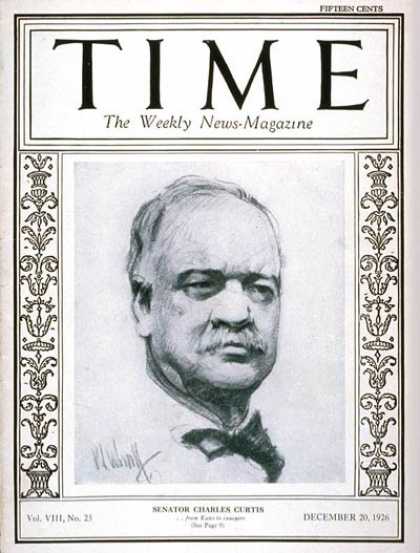
Tom Ricks is a well-regarded defense expert. But he also knows something about the vice presidency. His recent post referred to Charles Curtis (Herbert Hoover’s VP, who is most famous for being part Native American) and compared his criticisms of FDR to Cheney's criticisms of the Obama administration.

Unlike Cheney, Curtis was a DC non-entity as vice president (a good bio from the Senate Historian can be found here). Previously, he had been a major figure on the Hill (rising to Senate Majority Leader), but he was from the opposite end of the party from the nominee Herbert Hoover. He was added to the ticket for political balance. Hoover and Curtis didn't get along at all. In fact Curtis inspired the character Throttlebottom, in the Gershwin musical – a vice president who could only get into the White House on public tours. Quite the opposite of Cheney. I’ll have to do more research – but the fact that Curtis became chair of the Republican Senatorial campaign committee in 1935 indicates that he became a sort of defacto party chief/spokesman – leading a rear guard action against the Roosevelt revolution. (Not much came of this and Curtis died in February 1936.)

Curtis ended up being the last man standing in a leaderless rudderless party, so he became in effect the national figure – this despite has having little to do with the previous administration’s policies.
Conclusions
The basic guide of bureaucratic politics is “where you sit is where you stand” or more academically – your position shapes your perspective. The VP has almost no inherent bureaucratic interests (with a relatively small staff and no core policy portfolio.) But the national standing does seem to count for something – maybe part of my thesis will be nailing down exactly what.

It is worth noting that ex-VPs can’t always translate this into influence – Quayle for example. Obviously Quayle’s perceived shortcomings played a role, but so did the structure of the Republican party which is hierarchical and top-down. There is usually a pretty clear line of who get to be President in the GOP. Ford won the nomination in 1976, edging out Reagan. Reagan was next in line, his chief rival was Bush (who became his VP.) Bush’s chief rival and the "senior national Republican figure” was Senate Leader Bob Dole who won the 1996 nomination. Then there was a bit of a vacuum and W. won the nomination, edging out McCain – who was the nominee in 2008. Curtis had been a leading rival to Hoover and the Senate Majority Leader in his own right – he was next in line. But now, the Republican party is in a bit of disarray and Cheney is the last man standing - leaving him a platform to be critic-in-chief.

Tuesday, January 19, 2010

The VP & the Whole Equation

They usually regret it, because I will give an unsolicited lecture at the slightest provocation. The obvious answer is that the position has grown exponentially in importance within my lifetime and the Cheney vice presidency (or co-presidency in they eyes of some) has made the topic particularly “hip” from an academic standpoint. All of this is completely true.

But it isn’t the complete answer.

In his final novel, The Last Tycoon, F. Scott Fitzgerald wrote of Hollywood that it,
"can be understood … but only dimly and in flashes. Not half a dozen men have ever been able to keep the whole equation of pictures in their heads."
Hollywood is a complicated place, but it is dwarfed by the complexity of the United States government. Major political decisions are made on so many levels. The political science classic Essence of Decision gives a glimpse into this phenomenon. The author, Graham Allison (joined in updated editions by Phil Zelikow – of the 9/11 Commission) looks at the decision-making process during the Cuban Missile Crisis. He has three basic lenses to turn on the problem. The first is the rational actor – that is a unified state advancing its interests – in effect the geopolitical chessboard. The second lens is the organizational dynamics, the inputs and outputs of the major bureaucracies involved in the problem, which shape the information available and the options open to policy-makes. Finally, there is the bureaucratic politics model, which focuses on the policy and personality of the people involved in the decision – each with their own interpretation of national interest and their own “turf” to defend.

Yet Essence if Decision is a very limited case study. It was a highly focused situation over a specific period of time, which quickly took priority over all others, where the President had tremendous discretionary power, and many potential players were not part of the process. Most issues are far more complex and involve balancing priorities between an even greater range of actors including Congress and domestic interests. These problems are multiplied exponentially in foreign affairs because the bureaucracies and politics of other countries need to be taken into account. For example, I am currently reading Richard Neustadt’s classic The Skybolt Crisis in Perspective. JFK cancelled a missile program in order to cut the defense budget – but the missile program was crucial to the British because it was the only way for them to maintain their independent nuclear deterrent. Losing this deterrent could have led the British government to fall, and the U.S. needed its British allies on other issues and wasn’t sure the Labor leaders would be as helpful. But the alternative to Skybolt, submarine-based Polaris missiles, would hurt British integration with Europe – which, among other things, could potentially have led to a nuclear power Germany (this was written less than 20 years after WWII.)

In addition, decisions themselves aren’t single, solitary events and are often made with limited information. In the course of setting policy multiple decisions are made - some incredibly important, others seemingly relatively minor. Yet the minor decisions can have enormous consequences. Consider the “slam-dunk” of Saddam’s WMD? The major issue was whether or not to invade Iraq. But the seemingly peripheral issue of providing the moral/legal basis of the war was, at the time, not seen as a significant issue and made without rigorous analysis. When no WMD was found the administration’s credibility suffered a massive. What was the process in which a major possibility (that Saddam didn’t have WMD) was not carefully considered?

So, in effect, I want to get a glimpse at the broad process in which policy is made and implanted – the whole equation.

Why the Veep?
Why not?

Sometimes an important component in the equation, quite simply, a key person wasn’t in the room. The VP is a relatively new guy in the room. From relative obscurity, the VP has, for the past 35 years, been a major player. But there is nothing inherent about this role. The VP does not have the power of a cabinet department. At the same time, the VP is not locked into a position by a department. The VP is a protean figure that is shaped by what the President needs. But the VP is also a highly experienced figure that can give the President a broad perspective that incorporates the political, personal (FDR was famously hungry for gossip), and strategic.

Seeing how the Vice Presidency has emerged as a power-base and been used, both by its holders and by Presidents, to advance fortunes and positions seems like an excellent angle from which to catch a glimpse of the whole equation.