Tuesday, May 17, 2011

Essence of DSK: Do Leaders Matter?

Following the DSK imbroglio, one related story is that during a period of international financial crises the IMF (a critical institution) is leaderless. Of course, they have a deep bench of technocrats to make the trains run on time. On the other hand the present multiple financial meltdowns may be so severe and fundamental that nothing the IMF does would really make a difference – there are grand historical forces at work.

I mention this because a fundamental tenet of bureaucratic politics is that individuals and their preferences matter. If there is a single aspect to that perspective rooted in data rather then anecdote it is the question of “who is in the room.” Does it matter that the IMF doesn’t have a person of top rank to sit in on meetings. There is, of course, a number two but will DSK’s top office effectively respond to the number two’s leadership style?

This could be boiled down to the perspectives offered in the poli-sci classic Essence of Decision.

Model 1 (Rational Actor) vs. Model 2 (Organizational Behavior): Does the IMF matter or are events being shaped by deeper forces?

Model 2 (Organizational Behavior) vs. Model 3 (Governmental Politics): Will the IMF pretty much do its thing regardless of its leadership, or does DSK’s personal influence matter?

Really, my whole point here is best summed up by a far wiser Frenchman then DSK. Alexis de Tocqueville wrote:
I have come across men of letters who have written history without taking part in public affairs, and politicians who have concerned themselves with producing events without thinking about them. I have observed that the first are always inclined to find general causes whereas the second, living in the midst of disconnected daily facts, are prone to imagine that everything is attributable to particular incidents, and that the wires they pull are the same as those that move the world. It is to be presumed that both are equally deceived.
Sidenote, DSK's behavior is one good argument for the VP - someone needs to be available to step into the breach when less appealing aspects of human nature cause top leaders to be unable to attend to their duties.

Monday, April 11, 2011

The Trouble with Czars

In The Wall Street Journal today former Secretary of State, Treasury, Labor (and OMB chief) George Shultz decries the growth of White House staff at the expense of the cabinet.
The practice of appointing White House "czars" to rule over various issues or regions is not a new invention. But centralized management by the White House staff has been greatly increased in recent years.

Beyond constitutional questions, such White House advisers, counselors, staffers and czars are not accountable. They cannot be called to testify under oath, and when Congress asks them to come, they typically plead executive privilege.

The consequences, apart from the matter of legitimate governance, are all too often bad for the formation and execution of policy. The departments, not the White House, have the capacity to carry out policies and they are full of people, whether political appointees or career governmental employees, who have vast experience and much to contribute to the making of ­policy. When White House staffers try to formulate or execute policy, they can easily get off track in a way that would not happen in a regular department.

As secretary of state under President Ronald Reagan, I experienced this with great pain when White House people developed and ran an off-the-books program of arms sales to Iran. It erupted in the Iran-Contra scandal involving the unconstitutional transfer of funds not appropriated by Congress to the Contras, and with close to devastating consequences for the president.

Iran-Contra is a dramatic example, but the more general problem is the inability to take full advantage of available skills and expertise in policy making, and the difficulty in carrying out the functions of government nationally and internationally.
Shultz sees the impossible confirmation process as a primary culprit in this emphasis on White House-based decision-making. The inability to fill critical sub-cabinet ranks quickly makes it impossible for the president to get a firm rein on the bureaucracy. My advisor, Mac Destler, in his Presidents, Bureaucracies, and Foreign Policy discusses the President's need to create centers of strength at various levels throughout the bureaucracy. It is also fair to say that the record of White House czars is not a strong one.

There is other literature that suggests that there are regular patterns to Presidential centralization and dispersion of power. On key issues, the President puts the issue under the White House rubric until he has built the bureaucratic network he needs to further the issue. There is also the issue of scale. Presidents now appoint thousands when they take office. It isn't that these appointees are disloyal, but they probably don't know what the President wants and thus are liable to capture.

None of this is to say that Shultz's argument for easing the appointment process is not a good one - it is! His own record of success as a bureaucratic infighter is impressive (I hope he'll let me interview him when I get to that stage...)

One interesting note to the VP obsessed is that back in the mid-80s when the Reagan Administration couldn't figure out how to manage international terrorism Shultz apparently proposed VP Bush to head a Terrorism Task Force (I wrote a paper on it). Terrorism is THE inter-agency problem and a White House coordination effort was the only way to manage the process. But of course the VP is not a staffer, he (and one day she) is very much a public figure that is ultimately accountable.

Tuesday, March 22, 2011

Joe's Got no Action

The swirl of world events is incredible. Throughout the Obama administration, VP Biden has been in the center of national security decision-making. He liaised with leaders in Iraq and Egypt at critical junctures. He delivered speeches in Moscow, Beirut and elsewhere. So where is he now?

No court politics here, a review of the Vice President's schedule shows he is in regular meetings with the President and key national security figures - Combatant Commanders, SecDef, and this morning he hosted a meeting with the Secretary of State. But Biden is not taking a public role in explaining administration policy. Hillary Clinton and Robert Gates are, why not?

The VP has NO formal powers (unless specifically delegated by the President.) In upper levels of government, according to the classic Bureaucratic Policies and Foreign Policies a key question is "who has the action?" That is which official in which agency can actually sign off on an initiative. The VP doesn't have it. SecDef and SecState have a formal role in war-fighting and diplomacy. Having the VP out front in place of the President is useful in many situations, but not when forces are actually deployed. It would be Constitutionally and politically problematic to have Biden take a leading role.

Friday, March 11, 2011

Moe on the VP: Chemistry in the West Wing

Richard Moe, who had been Vice President Mondale's chief of staff, had an article in the Huffington Post about the rise of the modern vice presidency. A nice, brief overview from someone who actually knows the topic pretty well. Here is an excerpt:
Importantly, Biden gives every indication of being beyond personal ambition and solely dedicated instead to the president's agenda. Biden's predecessor, Dick Cheney, was beyond electoral ambition but not beyond personal ambition; he established a quasi-independent power center in the vice president's office that had an ideological agenda often at odds with the president's. There has not been a hint of self-promotion or free-lancing on Biden's part. He clearly understands that a vice president's influence does not depend on his visibility; just the opposite. It's no easy thing for a senator of 36 years who prizes his independence and prominence to give it all up for an office, however important, that is totally dependent on one person's discretion to delegate -- or withhold -- power. The trade-off, of course, has been the opportunity to affect policy and events in a way he never could otherwise.

Biden got off to a bit of a rocky start two years ago, but the verbal gaffes of that period have largely disappeared and the penchant for senatorial volubility has been restrained. Although they have very different life stories and personalities, he and the president have obviously developed a good personal chemistry and thus a good working relationship. It's a relationship that depends entirely on mutual trust and in the end both principals are the beneficiaries. But the country is the real beneficiary because it has a vice president whose office and abilities are being maximized for the public good, and because he will have the experience, information and skills to assume the presidency if, God forbid, he has to. Those are the two main criteria for a successful vice president in the modern era, and Biden meets them both. Thirty years ago I thought Mondale did too, but with Obama's help Biden has taken the office several levels beyond. If they keep it up, Joe Biden is on track to become the most consequential vice president in American history.
The line that caught my attention was that Obama and Biden have "good chemistry." What does that mean exactly, not simply that they like each other, although that is important. But politicians tend to be pretty likable, it is a basic characteristic of the profession. Politicians who are described as lacking charisma are still usually at least somewhat likable in person. I remember years ago at Fenway Park my friends were razzing a bullpen denizen. One of them, who is now a successful sportscaster observed, "You know, if he pitched for our college team we'd win a lot more games."

My point is that likability isn't the issue, the personal chemistry is much more than that. Nelson Rockefeller was immensely charming and remained friendly with Ford throughout the administration, yet he had limited influence. Distilling the elements of this chemistry is at the core of my thesis.

A few initial thoughts - first the VP has to actively seek to meet the President's needs. As Neustadt observed, the President as clerk has infinite demands on his time and energy. He does not need someone else giving him something to do. At the same time, the vice president is uniquely positioned to take things off the President's plate. The much derided "funeral duty" is actually an important one. The United States needs to send an appropriate representative, but flying around the world is is a huge drain on the president's time and energy. The same goes for rallying the base. With the President's confidence, these duties can be extended. As Stephen Hess wrote in a memo to Carter about expanding the VP's role:
...resist the temptation to give the vice president any assignments that the president would not assume himself if he had the time.

Friday, February 11, 2011

Rise of the Bidenites

A central component of vice presidential influence is allies on the President's staff. Paul Light's most excellent Vice-Presidential Power: Advice and Influence in the White House describes the importance of acquiring allies on the President's staff and of building warm relations between the vice president and president's staff. Mondale excelled at building alliances and placing allies in key positions. Also, because the Carter team was not familiar with the ways of Washington so that Mondale staffers had unprecedented opportunities to fill these gaps.

This has evolved since. While Bush and his team were somewhat suspected by the Reaganites, Bush worked hard to remove this image and - particularly significantly - his close friend Jim Baker was Reagan's chief of staff during the first term. Since Bush had his own team of experienced staffers, Quayle was challenged in building alliances and placing allies. Under Gore, the staffs had very close relationships and Gore was - by all accounts - a key player in the administration. Cheney's record in this regard may not have been as strong as is generally believed. The Bush staff was deeply loyal to Bush and had its suspicions of Cheney and his staffers. Formally, many Cheney staffers also held formal titles on the White House staff - a new development. Titles are important, but not everything. Probably the most important asset of Cheney's influence was (like Mondale's) a sense of what to do and how to do it.

Wall of Biden

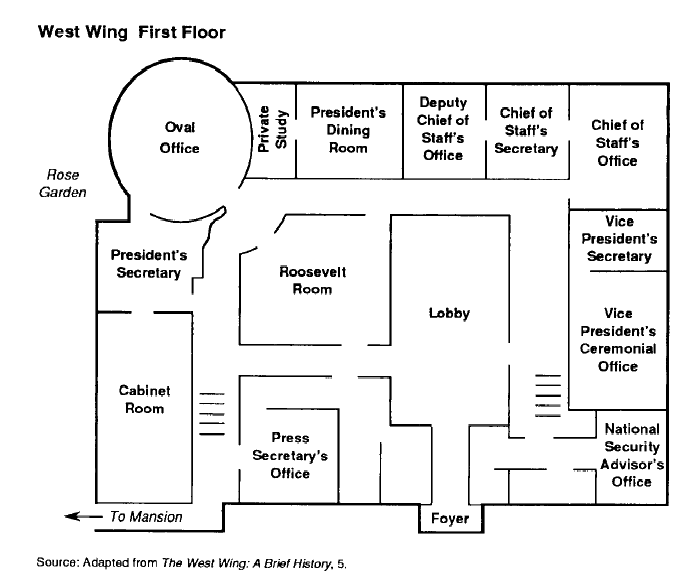
In evaluating palace politics, it is important to look at the floorplan.

According to the Washington Post profile National Security Advisor Tom Donilon is very close to Biden. He advised Biden during the Robert Bork confirmation hearings in 1987 and during Biden's 1988 presidential bid. His brother is also a long-time Biden advisor and his wife is chief of staff to Jill Biden.

The new chief of staff, Bill Daley, spent countless hours on the road with Biden during his 1988 presidential campaign.

In effect, that entire wall of the West Wing is occupied by Bidenistas.

Plus, the new press secretary, Jay Carney, had been Biden's press secretary. Off-hand I cannot think of a vice presidential staffer being promoted to the equivalent position on the president's staff. More than half of the West Wing's office space is filled with individuals with close links to Biden. That is unprecedented vice presidential influence!

Friday, January 21, 2011

VP as Presidential Peer?

Sometime ago I read Political Animal a fictionalized version of the Chuck Schumer - Alfonse D’Amato Senate race. The main character was a speechwriter and learned that his candidate (the novelized version of Schumer) knew about someone who'd been wrongly convicted for killing a police officer. Even though the campaign opposed it, the main character issued a press release announcing the candidate’s support for a re-investigation. The main character was fired and the candidate, when telling him off, said that he would still convert this to victory but that he was the one who was going to have to attend police benefit dinners and take the heat for this.

Reportedly, Lyndon Johnson once said about the Kennedyite intellectuals, “I wish some of these guys had just once had to run for dog catcher.” Ultimately, politicians have to win elections and do the kinds of things that win elections and take the public heat for their decisions.
A Senator has 99 colleagues who “get” what he or she has to deal with and interacts with them daily. A President has no one. There are long-time friends and advisors but they usually don’t have much direct electoral experience. As close as they may be to the President they are not, as William Kennedy wrote in his novel Roscoe describing the boss of the Albany Democratic machine, “…the main man, the man who forked the lightning, the boss.”

Supposedly, at a lower level, Karl Rove got into trouble on that front. He approached the Republican Congressional leadership as an equal. But in Congress there is a line between members and staff, and Rove was staff.

The Vice President is the one person in the White House who really has comparable experience. They have probably run several major campaigns themselves and went through a national campaign with the President. But unlike the staffers (who certainly share the crazy hours and frustrations) only the candidates have been subject to unbelievable scrutiny where reporters hungry to make a story carefully monitor every word while enduring endless speeches, handshaking, and questions from voters.

Rarely are the White House staffers individuals with national level electoral experience. Howard Baker, Reagan’s last chief of staff and a former Senate Majority Leader, is an exception. But he was pulled in under exceptional circumstances when the Reagan presidency was imploding. The VP is the only person around who might “get” both the substantive and personal aspects of what the President needs to do. In short, are VPs positioned to be a unique type of advisor and sounding board?

Tuesday, December 14, 2010

VP & Foreign Policy: A Brief Literature Review

Believe it or not there are already two scholarly books about the vice presidency and foreign affairs! Naturally I have read them both with great interest. First there is Paul Kengor’s Wreath Layer or Policy Player? The Vice President’s Role in Foreign Policy which was published in 2000 and was originally Kengor’s PhD dissertation. The second, and more recent book, is Jack Lechelt’s The Vice Presidency in Foreign Policy: From Mondale to Cheney, which was published in 2009. My initial reaction, since I am studying the same topic, was that neither was the definitive work on the topic – that is the book I will be writing. On a second read, I came away with a great deal more respect for what the authors accomplished and that the books provided some guidance about how to approach my own dissertation. Both of them are also chock full of key details and useful footnotes that make my own research much easier.

Wreath Layer or Policy Player?
In his dissertation Kengor explores two critical questions:

1. How the vice president fits into the president’s foreign-policy framework
2. Recommendations on how or whether the vice president can be used to enhance White House foreign policy

Overshadowing these specific questions is that of presidential training. Kengor notes that one important factor in the increased foreign policy role of the vice president was the rocky succession by Truman after FDR died. Not only did Truman not know about the atom bomb project, he was also unfamiliar with FDR’s negotiations with Stalin about post-war Europe and had not even met the Secretary of State. Because of that instance, there have been many recommendations for expanding the vice president’s role in foreign policy. Kengor notes that while there is merit to these recommendations, they should be carefully considered. One of the big selling points for an expanded vice presidential role is that the VP does not have an institutional affiliation – but Kengor notes that they do have political ambitions and that their actions can be shaped with an eye to their own future candidacies.

To examine his questions Kengor does a series of case studies on vice presidents who played an active foreign policy role. One of the real virtues of Kengor’s work (that I did not appreciate on my first read but became clearer as I face the challenge of identifying a question that can actually be answered) is that it is grounded in observable phenomena with reasonably clear metrics. Kengor has a simple schema with six levels of vice presidential activity:

1. Access to paperwork relating to foreign affairs and sitting on the NSC
2. Serving as a foreign policy spokesman
3. Traveling abroad as an emissary to meet foreign officials, make policy announcements, and/or serving as a liaison with congress
4. A vice presidential national security staff
5. Negotiating with foreign leaders on behalf of the administration
6. Chairing or participating in a key foreign policy committee

Kengor only does case studies on VPs who are at level five or more (Nixon, Mondale, Bush, Quayle and Gore – Cheney hadn’t been vice president yet.) In the case studies, Kengor examines the VP’s place in the administration’s foreign policy process and then discusses various vice presidential actions in the national security realm. Kengor notes that he made it a point to emphasize negative results from vice presidential engagement. Identifying positive or negative outcomes from a political event is a dicey business. But it appears that the metric is whether the administration got what it wanted out of the event. For example in 1983 VP Bush traveled to Europe to push for the deployment of Pershing missiles, which was running into domestic opposition in the potential host countries. By all accounts – both in the general press and from administration figures - Bush did a fine job, bolstering deployment supporters and responding to critics. On the other hand in 1986, Bush went to Saudi Arabia to encourage the Saudis to keep oil prices low, which was devastating the Soviet economy. Instead Bush told them the US needed price stability, the opposite message the Saudis had been getting from Reagan and his senior cabinet officers. Kengor hypothesizes that low oil prices were hurting the oil industry and the states where it is based and that Bush wanted their support for his own upcoming Presidential run. There are similar examples in other vice presidencies (a Mondale statement in South Africa derailed the administration’s Africa policy – but may have helped Mondale with civil rights groups in the US.) This is an important observation, that while a VP may be free of institutional interests, he is not free of political ones that may run counter to the President’s wishes. It is worth noting that in the Gore-Chernomyrdin Commission, Gore may have acquired a loyalty to Russia policy, which was somewhat institutionalized under the GCC.

Kengor states that VPs at the end of their career may be better able to serve the President objectively and not seek to protect their future political careers. Since the publication of Kengor’s book the United States has seen two VPs who saw that position as the apex of their career – Cheney and Biden. In some respects Kengor’s observation seems correct – Cheney and Biden’s service (for better or worse) appears to be entirely focused on serving their President. However, under Cheney the recognition that this would be the VPs only opportunity to make policy at this level may have led to a highly public activist role that created rifts and tensions in its own right. Although it was not a foreign policy issue, there may have been a hint of this in Nelson Rockefeller’s difficult tenure in the vice presidency under Ford. Rockefeller hoped to “run” domestic policy. He was sidelined by Ford’s chiefs of staff – Donald Rumsfeld and Dick Cheney.

In his conclusions, Kengor addresses 20 policy recommendations on the vice president’s national security role. Nine of the recommendations (including serving as a member of the NSC, receiving all presidential papers, having a West Wing office and a regular private meeting with the President) are seen as musts for a vice president to be in the loop on foreign policy. Another six recommendations (including serving as a general advisor or congressional liaison, chairing a short-term task force, or serving as emissary or foreign policy spokesman) are viewed as potentially feasible depending on the President’s preferences. Finally, five proposals including having the VP head an executive-level department or chair a major interagency committee are rejected because they could place the VP in the midst of turf battles and because if the VP is unsuccessful the president could be placed in the very awkward position of removing him (or her – although presumably future female vice presidents will be models of competence.) These are excellent points about the vice presidential role.

Kengor does not discuss in much depth the drivers for the increased vice presidential role. He mentions the National Security Act of 1947 and the increasing responsibilities placed on presidents since WWII. But those explanations seem inadequate. Although Nixon was given a greater role than any previous VP, the position then entered 15 years of marginalization. Nelson Rockefeller, who was appointed by Ford to shore up the legitimacy of his own unelected presidency, resurrected the vice presidency (although he focused on domestic policy). This expanded role was further increased under the Carter-Mondale administration. If Carter had not been willing to break the mold of vice presidencies by making Mondale a full partner it is not inevitable that the vice presidency would have fundamentally changed. Carter’s own election was the product of Watergate and the resignations of Nixon and Agnew. That being said, this issue may have been beyond the scope of questions Kengor sought to address.

Another area Kengor does not discuss in much detail is the vice president as an advisor. He describes some vice presidents as offering advice, both privately and in NSC meetings, but there is no discussion of the impact of VP advice. Under what circumstances were the VP’s preferred options accepted or rejected? This is not a shortcoming, rather an observation that will be discussed in greater detail below.

The Vice President in Foreign Policy
Lechelt’s book was not, apparently, his PhD thesis. It covers similar ground, although it does not include Nixon and does include Cheney. His major finding is the “semi-institutionalization” of the VP’s policy role. Paul Light in Vice-Presidential Power: Advice and Influence in the White House describes the institutional expansion of the VP’s office including its own budget and dedicated personnel. Without these changes the VP simply does not have the resources to play an effective role. (Ford, as a condition for accepting the vice presidency, demanded his own typing pool – because he knew that otherwise his work would be at the bottom of the White House job queue.) However, Lechelt discuses the expanded prestige of the position – regular private meetings with the President were instituted under Carter but have became SOP. This has fostered a defacto expectation that the VP act as a policy player. Lechelt cites Joel Goldstein’s The Modern American Vice Presidency which notes that once one President gives his VP this access, it is hard for the next President to revoke it. I would expand on that observation – in picking a vice president the president is effectively telling the American people that they would pick this individual above all others to be president in their place. This is an important statement and to follow that up by not including the VP in policy deliberations would effectively send the message that president did not take their VP selection seriously and call the President’s judgment into question.

Lechelt finds that it is likely that VPs will continue to be substantial policy players. In this, Lechelt’s case study of the Quayle vice presidency is crucial. Lechelt takes note of the insider-outsider paradigm and explains that Quayle was serving an insider President who was well-versed in foreign affairs and had strong relationships with his top advisors (particularly Jim Baker the Secretary of State but also NSA Brent Scowcroft.) Nonetheless, while Quayle did not play the role played by Mondale, Gore, or Cheney he was in the mix. Bush’s key advisors were known as the “Big Eight” and Quayle may have been last on the list – but he was on the list. He was not in the innermost circle of advisors, but he did play a role and even persuaded Bush 41 to adopt his position on missile defense. A reduced role compared to his immediate predecessors and successors – but a vast role in comparison to 90% of the vice presidents who had gone before him.

It is beyond the timeframe of Lechelt’s work, but Biden’s active role in the Obama administration highlights this argument in the other direction. For Obama’s supporters the Cheney vice presidency was an awful situation that had led to bad policy and skirted the edges of constitutionality. Biden effectively promised he would not be another Cheney. Yet – he was quickly given prominent roles and has been the administration’s fireman on a range of issues including disputes in the intel community, coalition building in Iraq, and pushing START through the Senate. He has also played a leading role as an advisor – particularly on the issue of the Afghan surge. Biden’s role may be less then Cheney’s but it is obviously substantial (apparently more than Quayle’s and probably comparable to Gore and Mondale.) This indicates that, as Lechelt argues, the VP remains well positioned to play a leading policy role.

Both Kengor and Lechelt spend a fair amount of time analyzing that which can be observed clearly – vice presidential travel (for example.) This brings up an interesting point about future vice presidential roles. In an essay included in At the President’s Side: The Vice Presidency in the Twentieth Century the great Richard Neustadt observes the president effectively controls the vice president’s schedule. Even if the two officials get along, the President might find the most effective use of his VP on the road – fundraising, speaking, and meeting officials. Reducing the VP’s role would have to be done with subtlety – but it could be done.

This leaves open my question of what does the VP bring to the table that makes having him (or her) worth keeping around the White House? Perhaps the question I am interested in is the VP as senior advisor. Unfortunately this is difficult to test. Paul Light tracked cases where the VP advocated a policy and it was adopted. This approach has a number of disadvantages – one of which is Light only had two VPs in office for about 5 years (Mondale and Rockefeller.) I would have to gather data on 30 more years of vice presidents! I don’t have that kind of time if I want to finish my thesis before I retire. Also, advice isn’t always up or down on policy. VPs can have other kinds of impact – such as how an issue is portrayed or on key appointments. One metaphor that comes to mind is the VP as back-up QB. Besides being ready to take the field at any moment, can the back-up QB serve as a peer advisor to the QB and offer unique counsel. The VP is usually the only other senior politician in the White House – the only other figure who has had to actually run the political races and make the big policy calls. Can someone who shares that perspective be inimitably useful to the President?